
Stage show · Czechia
A stage appearance in front of a full hall
The robot as an item in the programme in its own right — not an exhibit in the corner.
Hire a humanoid robot that welcomes your guests, moves among them on its own and answers in their language. We bring the robot, the operators and a script written for your programme. Up to four robots at one event.
Tell us the date, the venue and the type of event — we reply with an itemised quote within 24 hours. No price list: every event is priced individually.
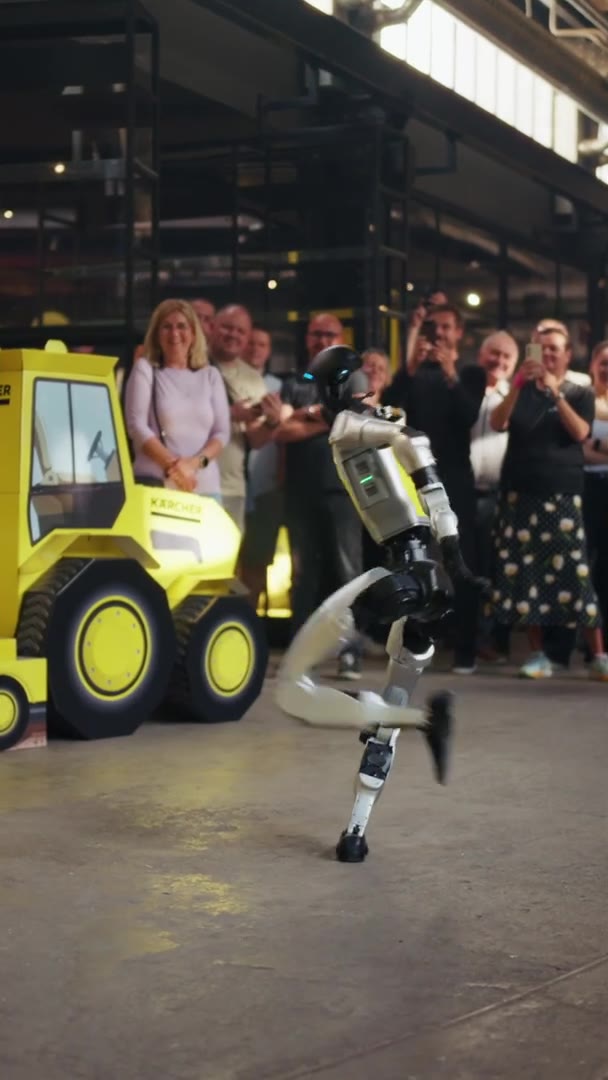
Not renders, not manufacturer footage. Every clip below is from an event we delivered.
The robot as an item in the programme in its own right — not an exhibit in the corner.

Welcoming guests, appearances during the programme and the evening awards — one script.
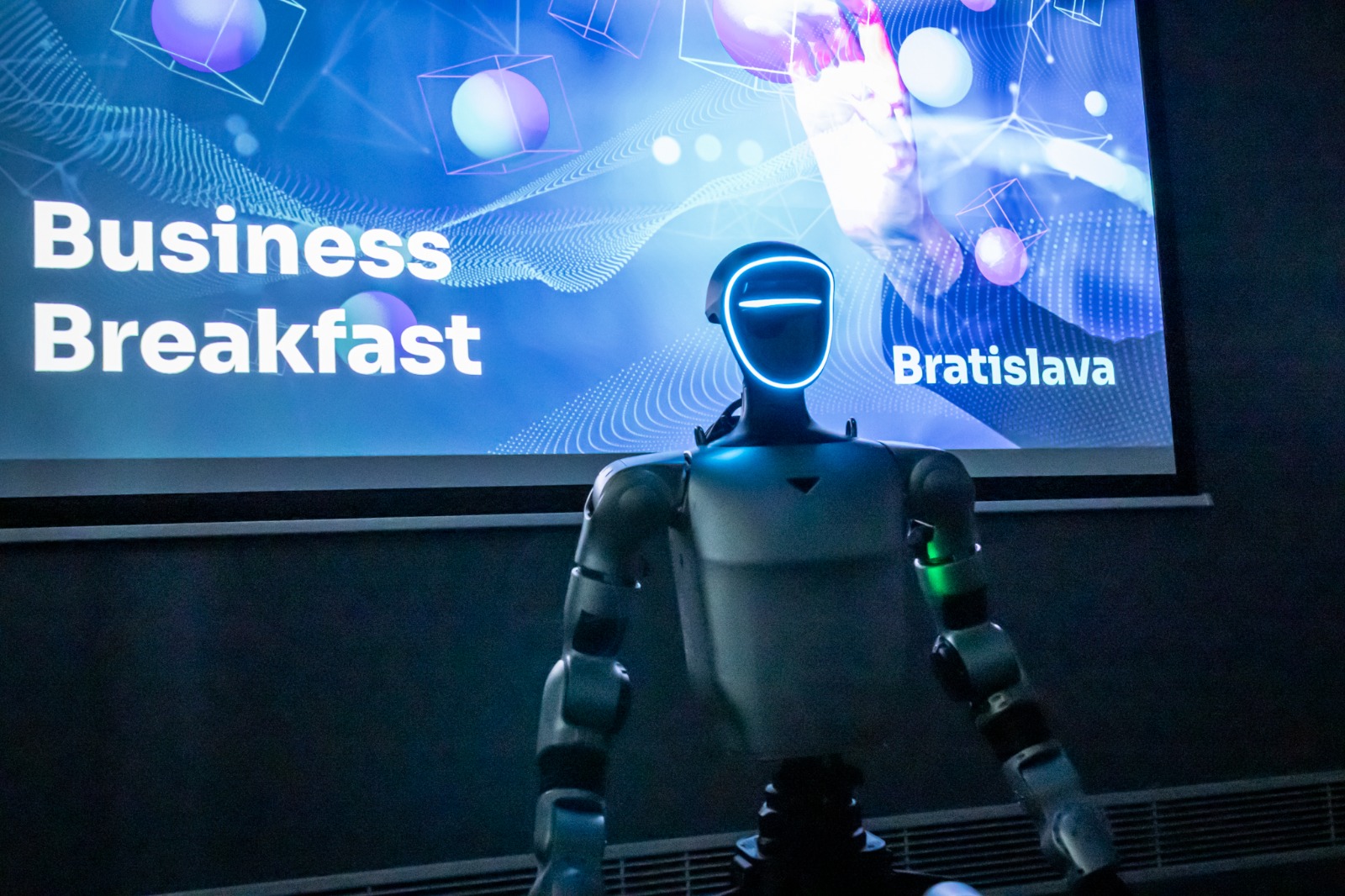
A technology demonstration built to support the topic and the conversations in the room.
Give visitors a reason to stop at your stand — and your staff a natural reason to start a conversation.
A technology theme gets a physical form. The robot supports the opening, a scripted dialogue or the reveal.
Welcoming guests, a spot with the host, or one strong moment during the awards.
People usually ask what they are buying by the hour. This is the honest shape of a day, taken from the events we run.
The crew arrives with the robot in its flight case, unpacks it, calibrates it and walks the space it will be working in. We look for cable ramps, steps, glass doors and anything shiny enough to confuse a depth camera, and we agree where the charging station stands.
We test the connection, run the robot's lines once out loud, and rehearse the moments that have to land exactly: the entrance, the handover with your host, the award. If your host has never worked with a robot before, this is when that stops being true.
The robot is not on continuously, and anyone who tells you otherwise has not run one all day. It works in cycles of about twenty minutes of active walking and talking, then stands and rests for ten. That is thermal management, not battery life — packs swap in under two minutes. In an eight-hour day expect around five to six hours of genuinely active presence. During the rest periods the robot still stands in the room and still photographs well.
One or two moments per event carry it: the entrance, a scripted exchange on stage, the award handover, the group photo. We agree them in the brief and rehearse them. Everything between those moments is the robot moving among guests and talking to whoever approaches it.
Case, charging station, cables, and we are out of your way. If a video crew is part of the brief, the edit follows within five working days.
Three machines, three different jobs. Most events want the first one; a few genuinely need the second.
The workhorse. Walks among guests, holds a conversation, poses for photographs, performs a scripted spot. Easier to move, easier to place on a stand, and the right answer for the large majority of events.
Human height, so it meets people at eye level and reads as a figure in the crowd from across a room. This is what you want when the robot has to hold a stage or wear clothing that only works at full scale. As far as we know it is the only one available for hire in the EU.
Fast and agile where a humanoid is deliberate. It works aisles and corridors, draws people back to a stand, and handles movement a walking humanoid cannot. It does not talk — it is a presence, not a host.
Up to four humanoids can work one event together. More than one robot changes the effect entirely: they interact with each other, and there is never a dead moment while one of them swaps batteries.
The robot answers in the language it is spoken to, across thirteen of them, including English, German, French, Spanish, Italian, Polish, Czech, Slovak, Hungarian, Russian, Arabic, Vietnamese and Chinese. That is the part guests remember: a visitor speaks their own language and gets an answer back in it.
What it says is not improvised. Before the event you approve a persona — who the robot is at your event, how formal it is, what it is proud of — and a knowledge base of what it may talk about. Scripted lines carry the fixed moments; live conversation handles everything else, but stays inside what you approved.
Three things it will never do: quote a price, make a claim about your product that you have not signed off, or answer a question it should not have an opinion on. If a guest pushes into that territory, it says so and points them to a human.
If the venue's connection fails completely, the robot falls back to the sequences stored on board and keeps going. A stand does not go quiet because the Wi-Fi did.
Two trained operators are with each robot for the whole event. The robot is autonomous in how it moves and speaks; it is never unsupervised among people. One operator is always within reach of a stop.
We agree a zone before guests arrive. The robot walks — it does not run — and keeps its distance using LiDAR and a depth camera. Around children and dense crowds we shorten the zone rather than trusting the sensors alone.
A 230 V socket within reach, a level and dry surface without deep carpet or cable ramps, and 30 to 60 minutes before guests for set-up. Steps and thresholds we need to know about in advance, not discover.
Filming and photography are agreed beforehand. If your guests must not appear in our material, say so in the brief and nothing from the event is published. If minors are involved, written consent from a parent is required before we film — that is on the organiser to arrange, and it needs doing early.
We are based in Prague. Czechia and Slovakia are routine; Germany, Austria, Belgium, the Netherlands, France, Italy, Poland and Portugal are regular; and we travel to the Middle East, including Dubai and Saudi Arabia.
Across Europe the robots travel by road, in flight cases, in our own vehicle with the crew. That is not a preference. The lithium packs that power them are classed as dangerous goods, and putting them on an aircraft is slow, expensive and — on some routes — not something we would stake a client's event on. For destinations beyond road range we fly the robots without their batteries and source packs locally before the event.
This is the single thing that most surprises people about the cost. A distant event does not block a robot for a day, it blocks it for several — travel out, the event, travel back — and that, rather than the hours on site, is what makes distance expensive. It is also why a foreign booking needs weeks of notice rather than days: customs paperwork, an ATA carnet and visas all have fixed lead times that nobody can shorten.
We do not publish a price list, because every event is different: the date and location, how long the robot is present, how many robots, the scope of the programme and the transport. Send us the brief and you get an itemised quote within 24 hours.
We travel from Prague across Czechia and Slovakia routinely and across the rest of Europe regularly — Germany, Austria, Belgium, the Netherlands, France, Italy, Poland. We also serve the Middle East, including Dubai.
Yes. The robot is always accompanied by our own trained operators. This is not self-service hire.
Up to four humanoids at one event. More robots means more operators, a second vehicle and a synchronised choreography, so tell us early.
No, and we will not pretend otherwise. The outcome depends on the audience, your offer and how you follow up the contacts. We will help design the activation and the measurement.
Thirteen languages, and it answers in the one it is addressed in. If your audience is mixed, that is the point — a guest starts in their own language and the robot continues in it.
For an event in Czechia or Slovakia, a couple of weeks is comfortable and we have covered shorter notice. For a foreign booking count on several weeks: the persona and script have to be approved, and transport paperwork has fixed lead times. Peak season is the autumn and December, when dates go early.
Yes, with a defined working area and our operators present throughout. The robot walks rather than runs and keeps its distance using LiDAR and a depth camera. Around children we shorten the zone and slow the robot down rather than relying on the sensors alone.
Yes — a wrap in your colours, a jersey, clothing, or a badge holder. It is agreed and produced before the event, not improvised on the day, because the material has to leave the robot's cooling vents clear.
Yes. A shoot day is a different product from an event: the robot, the crew and a script written for your space, with finished video delivered afterwards. Tell us what you want to walk away with and we will quote it.
We bring our own connection and do not rely on venue Wi-Fi, which is usually saturated at large events. If everything fails, the robot continues with the sequences stored on board.
We will recommend a format, check availability for your date and send an itemised quote within 24 hours. Non-binding, no sign-up.